
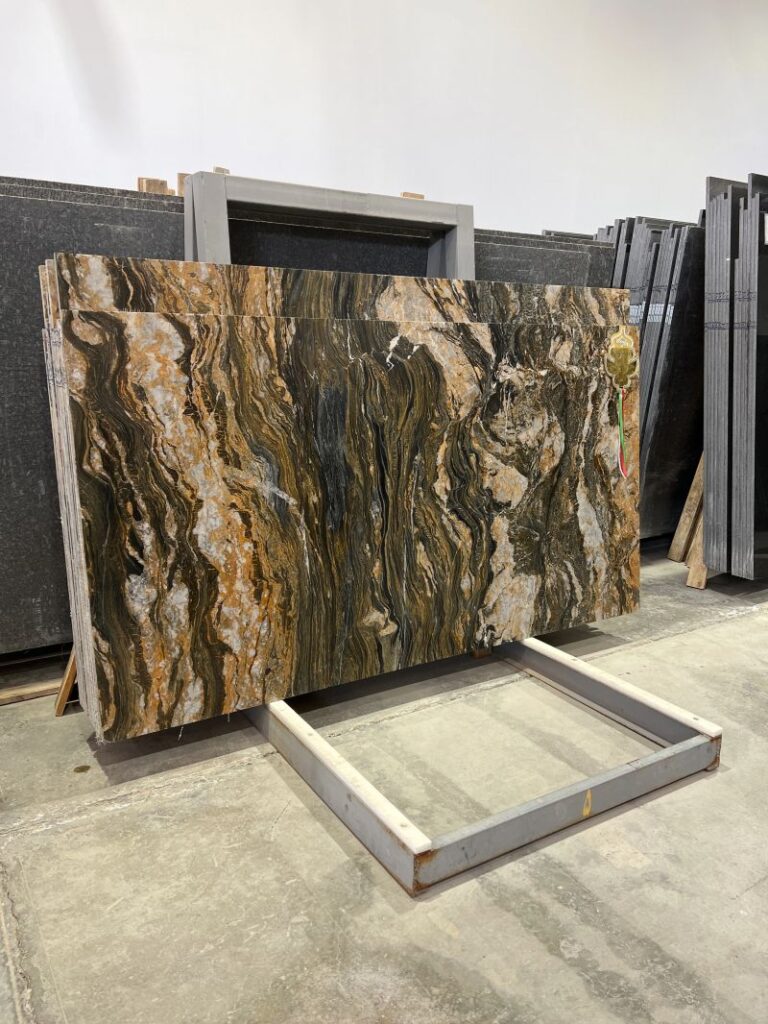
While travertine is Iran’s most famous export, Persian Marble is equally prestigious, offering a spectrum of colors—from the world-renowned “Pietra Grey” to deep “Golden Black.”
Top Persian Marble Varieties for Export
If you are sourcing for a specific aesthetic, these are the most “in-demand” Iranian marbles:
- Pietra Grey (Lashotor): Perhaps the most famous Persian marble. It features a sophisticated charcoal/grey background with fine white veins, closely resembling expensive Italian varieties but at a more accessible price point.
- Golden Black: A striking deep black marble with distinct golden and white veins. It is a staple for luxury feature walls and high-end hotel lobbies.
- Persian Silk (Silk Grey): A light-to-medium grey marble with a unique “silky” texture and minimal veining. Very popular for modern, minimalist flooring.
- Royal Botticino / Dehbid: A premium cream-colored marble known for its high density and exceptional polish. It is widely used for large-area flooring in luxury villas.
- Harsin / Khoy: The “workhorses” of Persian white/beige marble. They are incredibly durable and offer a clean, bright look for commercial spaces.
Important Sourcing Factors
Finish Options: Beyond standard “Polished,” Persian marble is often available in Brushed, Honed, or Sandblasted finishes, which are trending for 2025 exterior and non-slip applications.
Quarry Ownership: Suppliers like MGT Stone and Motstone own several quarries. Buying from a quarry owner ensures better color consistency across large orders compared to a general trading company.
The “Crystal” Sub-Category: In Iran, many “White Marbles” are technically Crystalline Marbles (like Azna or Neyriz). These are harder and less porous than standard marble, making them better for high-traffic floors or bathrooms.
Regional Hubs: Isfahan is the epicenter of the Persian stone industry. Most major suppliers have their primary processing factories in the Mahmoud Abad or Shams Abad industrial zones.